Key message — Environmental policies cannot be limited to protecting nature from the practices of local populations. They must recognize that these populations have another legitimate way of assessing their environment, grounded in their daily needs, their memory of the place and their sense of belonging. Biodiversity protection therefore calls less for “pedagogy” than for co-construction: ecological objectives must be brought into line with a substantial improvement in living conditions. In other words, an effective environmental policy must also be a successful social policy.
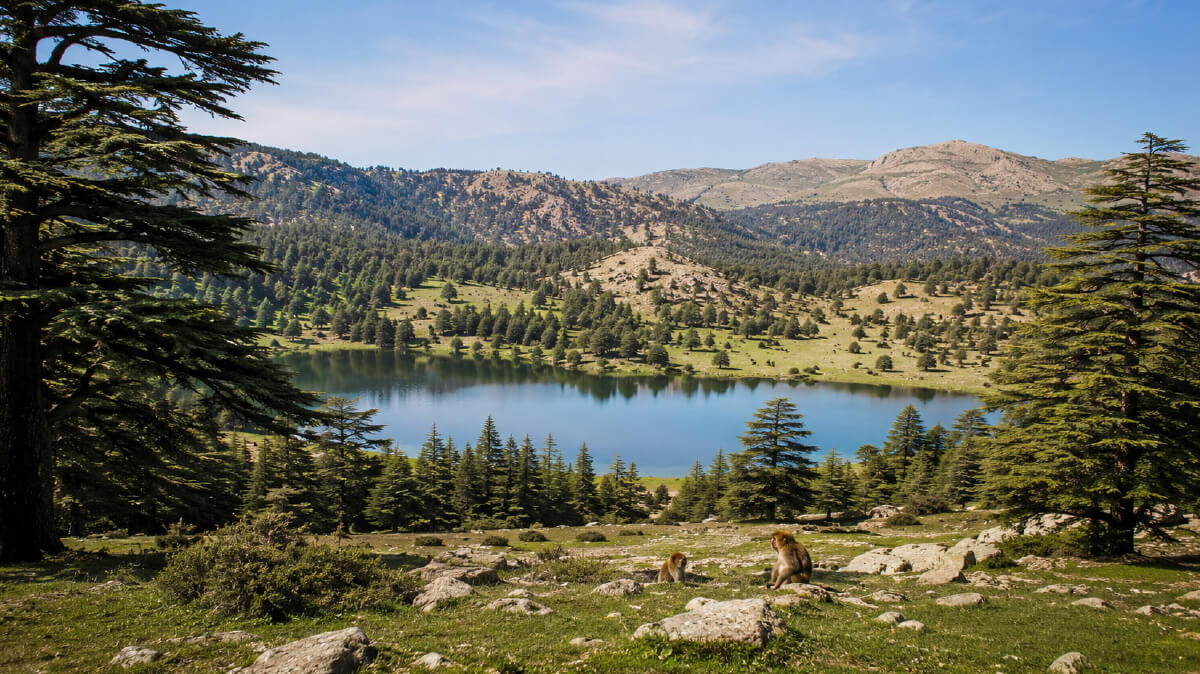
As part of an IPORA project[1], we conducted field research in Khénifra National Park, located in the Béni Mellal-Khénifra region. Created in 2008, the park covers 202,700 hectares and forms part of the Atlas Cedar Biosphere Reserve. It aims to preserve fauna, flora and several endemic species, notably the Barbary macaque, also known as the magot, while promoting ecotourism, reforestation and income-generating activities for residents. These are public policies with two sets of addressees: (a) living species and, more broadly, an ecosystem, and (b) the people who live there. This always introduces a degree of complexity, since public policies are no longer focused solely on the interests of users, that is, the park’s current residents.
On the contrary, the policies implemented in the national park seek to encourage residents to abandon certain practices considered predatory, such as illegal logging or poaching. Around Lake Aguelmame, the old huts built by residents to welcome visitors were thus destroyed and replaced by a developed platform set back from the lake and attached to a parking area. More than forty families benefit from this arrangement, but it is considered less profitable than the former facilities, which were closer to the lake, more practical and more pleasant for visitors. The question naturally arises of how to reconcile the impersonal interests of the ecosystem with the personal interests of the park’s residents. But this may be a short-sighted question: the issue seems rather to be how to take account of different perspectives on the resources of an ecosystem, based on different experiences and needs.
The first results of the survey
The survey, which is still ongoing and is based on some thirty interviews and several sequences of participant observation, shows that residents do not perceive their presence in the park in the same way as the authorities or nature-protection organizations. They do acknowledge certain material achievements, such as the facilities, access roads and reception areas. But they also point to unfulfilled promises, notably their relocation to a permanent village near the catering platform, as well as the installation of electricity.
Above all, the interviews revealed a deep divergence concerning the state of the cedar forest and environmental priorities. Where the Park authorities and civil society organizations consider that the forest is deteriorating, residents believe that it remains dense and that new cedars are growing. This difference is not due to an inability to assess the environment: on the contrary, residents are very attentive to drought, which affects herds, livestock farming and even the possibility of keeping donkeys. Rather, it stems from different assessment criteria. The authorities reason in terms of biodiversity, biomass and the long term; residents assess resources on the basis of daily needs, household budgets and the visible regeneration of the forest. The same divergence appears with regard to the protection of endemic species, sometimes invisible to the naked eye. For the authorities and NGOs, the aim is to preserve fragile habitats; for residents, the issue is to preserve their access rights to springs, watercourses and land needed for livestock farming. They do not therefore necessarily reject the environment, but interpret it from another frame of reference. Finally, residents clearly consider themselves to be “at home”. They do not see themselves merely as a population living in a protected administrative area, but as members of a community for which this space is an immemorial place of belonging. The park’s resources therefore appear less as an abstract common good than as a good of their own.
The dual burden of environmental public policy
This situation invites us to think of environmental policies not as simple protection mechanisms coupled with awareness-raising measures, but as processes of mediation and co-construction with local populations. Very often, the promoters of public policies — especially, though not only, when they are political actors — consider that they need to provide “pedagogy” to the target populations. The term, however well intentioned, is problematic because it establishes a typical educational relationship between teachers and pupils, with the former possessing knowledge and instructing the latter. Pedagogy is not a relationship between equals; moreover, it assumes that the framework for learning is shared. When practices and interests diverge, this is not the case. What is needed is less pedagogy than inclusiveness.
It is therefore worth going further and, while accepting that perspectives are legitimately different, asking how they can be made to converge. This would mean reflecting together on what a dense cedar forest actually is and perhaps consulting old photographs of the place in order to judge. One of the effects of climate change is that it also alters environmental memory. We can thus end up forgetting part of what has been lost. Nor is that all. The timeframes are not the same: for the residents of the natural park, preserving the cedar forest and its biodiversity does not necessarily appear more important than the deadlines of everyday life: children’s needs, instalment payments and unexpected expenses. From the standpoint of timing alone, these deadlines take priority.
Environmental public policies cannot confine themselves to protecting nature by substituting virtuous income for income derived from informal or predatory practices. They must necessarily do better, so that it is not tempting to add these incomes together rather than substitute one for the other. Working to preserve the environment has as its corollary — if not as its precondition — the need to combat inequalities effectively. The burden of environmental policies is necessarily dual — and their budget should therefore be dual as well.
Jean-Noël Ferrié
LAM, UMR 5115 CNRS, Sciences Po Bordeaux
[1]https://ipora.africa/news/projet/the-normative-embedding-of-environmental-evidence-controversies-surrounding-climate-change-in-africa/. This project is co-led by Yousra Abourabi (UIR Rabat) and Jean-Noël Ferrié (CNRS Bordeaux).