How can smallholder farmers be encouraged to adopt agricultural practices that benefit not only their own livelihoods, but also nutrition, food safety and environmental sustainability?
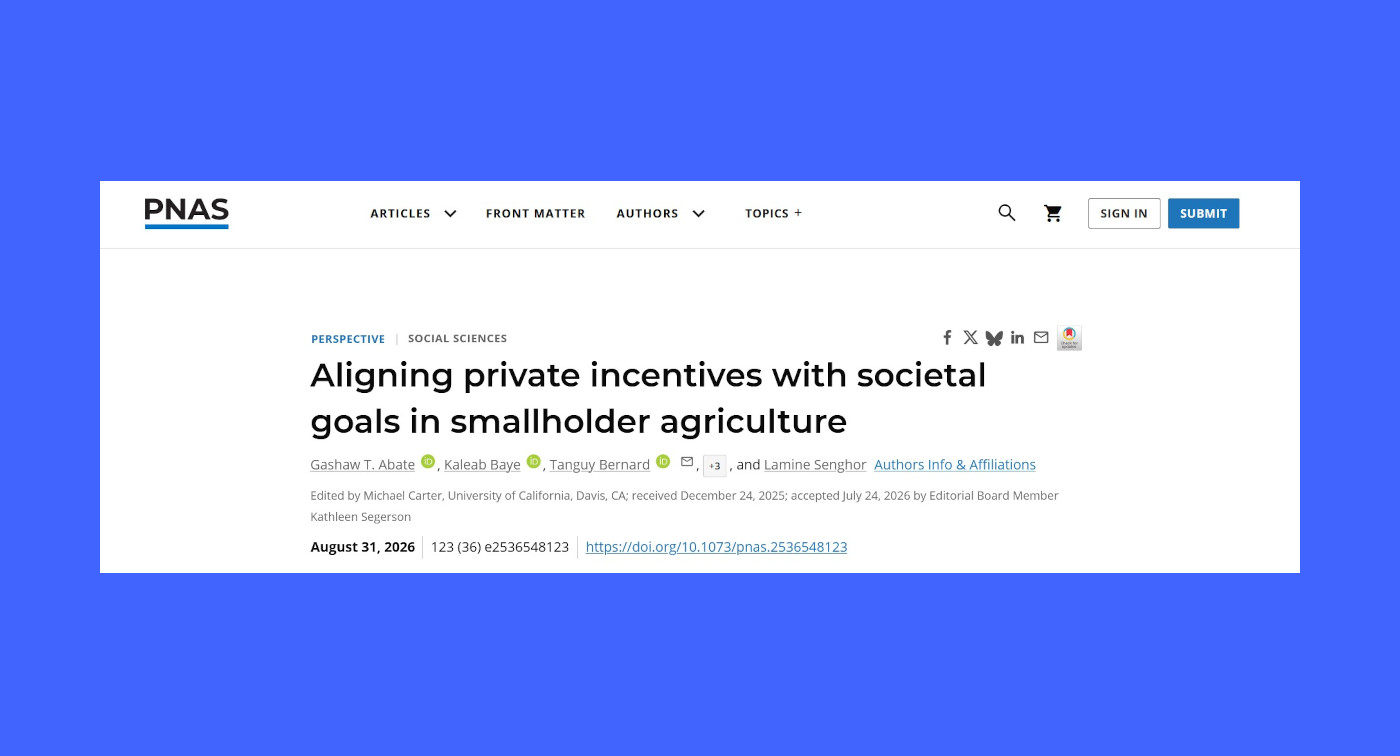
A new study published in Proceedings of the National Academy of Sciences (PNAS) on August 31, 2026, addresses this question by examining the factors that influence farmers’ decisions to adopt socially beneficial agricultural practices.
Small-scale farmers in low-income countries are often encouraged to adopt new inputs and practices that can generate significant benefits for society. Yet adoption may remain limited when the benefits for individual farmers do not sufficiently compensate for the costs and risks they face, or when access to finance, information and appropriate incentives is lacking.
The authors propose a conceptual framework to better understand these barriers and identify the policy levers that can help overcome them. Rather than looking for a single solution, the study highlights the importance of combining different types of interventions — economic, financial, informational and technological — according to the specific constraints farmers face.
The framework is applied to three areas with important implications for sustainable food systems: aflatoxin mitigation, biofortified crop varieties and conservation agriculture. These examples illustrate how different combinations of policy instruments and emerging technologies can help align farmers’ individual incentives with broader societal objectives.
The study brings together expertise from several institutions and disciplines and includes Kaleab Baye and Tanguy Bernard, members of the IPORA network, among its co-authors. The publication also acknowledges IPORA among its funders, illustrating the network’s contribution to interdisciplinary research connecting agriculture, economics, nutrition and public policy.
Read the full article:
https://www.pnas.org/doi/10.1073/pnas.2536548123
Aligning private incentives with societal goals in smallholder agriculture
Gashaw T. Abate, Kaleab Baye, Tanguy Bernard, Jordan Chamberlin, Ruth Hill, Rachid Moussadek and Lamine Senghor.
Proceedings of the National Academy of Sciences (PNAS), 2026.