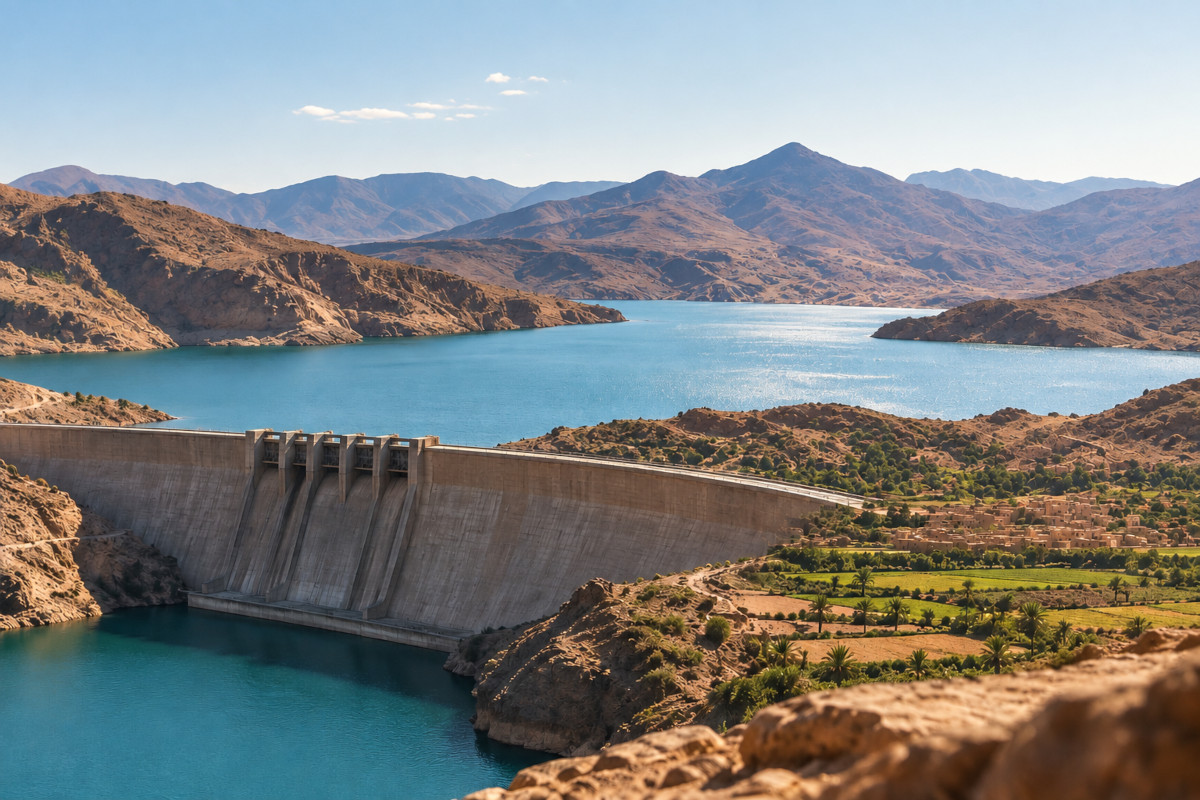
Key message –Although Morocco’s dam policy is ostensibly instrumental and geared towards rural development, it primarily serves as a lever for maintaining social stability. Through the staging of state power and the strategic allocation of resources, hydraulic infrastructure has enabled the state both to project its authority and secure the loyalty of local elites, thereby postponing structural reforms. The analysis shows that spatial planning goes far beyond the technical management of resources, as the disconnect between hydraulic engineering and scientific assessments prevents distributive conflicts from being addressed. However, recurrent droughts and growing water scarcity are now undermining this social contract, shifting conflict from the technical sphere into the public arena. The sustainability of water management therefore depends on a reorganisation of relations of production and access to land. In other words, an effective water transition policy must also be a policy aimed at transforming social structures.
Morocco is facing water stress of unprecedented severity, following six consecutive years of drought. In response to dwindling water resources, the dam policy initiated under Hassan II and intensified under Mohammed VI has consistently been presented as the only rational response capable of averting the spectre of collapse caused by water scarcity. Yet the construction of this infrastructure reflects a fundamental political choice: consolidating local hierarchies rather than modernising the social structures of rural areas.
Confining expertise to specialised circles
To provide an objective assessment of these dynamics, our research relied on a qualitative analysis combining the study of public policy documents, expert reports and geographically disaggregated electoral data. The findings show that the construction of major hydraulic infrastructure enjoys massive public support, in striking contrast with the abundance of scientific reports that have, for several decades, warned of the dead ends inherent in such a trajectory, characterised by prohibitive financial costs, widening territorial disparities and the accelerated depletion of groundwater reserves.
Dependence on infrastructure has taken precedence over ecological assessments, with the state preferring to subsidise the continued expansion of an agricultural model centred on export rents rather than heed climate and hydrological modelling. Yet the silting of reservoirs, the lack of upstream erosion-control measures and the unequal distribution of water in favour of large, mechanised agro-export farms have all been extensively documented and brought to policymakers’ attention.
The decision to disregard these warnings stems from a deliberate compartmentalisation of knowledge. The hydraulic paradigm has established itself as the only legitimate framework for action precisely because it makes it possible to avoid any challenge to the patriarchal order, the organisation of extended family structures or the customary regulation exercised by local notables.
Major infrastructure, minor arrangements
A historical perspective sheds light on a process whereby structural reforms have been postponed through the discretionary allocation of water resources. While aspirations for social justice initially underpinned plans for redistributive agrarian reform, opposition from large landowners led the authorities to abandon this option as early as 1963. Ambitions for land redistribution subsequently dissolved through a revealing semantic shift: “agrarian reform” was gradually sidelined in favour of a simple “agricultural reform”, before being definitively neutralised by the 1969 Agricultural Investment Code.
By retreating towards a policy focused on increasing supply, the central government defused political dissent by insulating the agrarian order from any attempt at restructuring that might challenge land monopolies.
Massive investment in hydraulic concrete infrastructure was accompanied by a genuine staging of political power. Ceremonial inaugurations, commemorative plaques and national mottos engraved on these structures contributed to the sacralisation of infrastructure, turning it into a monument to state sovereignty. Spatial planning thus came to embody a Promethean vision of public power, in which the technical mastery of nature became an instrument for bringing rural areas under state control.
In this sense, dams did not so much ward off the effects of drought as postpone reform. They stabilised a “rural compromise” in which water irrigates not only the land, but also political loyalties.
The perpetuation of these allegiances has shaped an asymmetrical electoral geography in which the allocation of water resources influences voting patterns. Dams function as instruments of strategic allocation, comparable to the clientelist mechanisms associated with pork-barrel projects. Irrigation and subsidies make it possible to reward allegiances and consolidate the state’s foothold in peripheral areas. Central authority becomes entrenched by maintaining these loyalties, which mirror the country’s spatial divides.
This system helps explain the profound electoral divergence between urban and rural areas. While cities express distrust through high abstention rates or protest votes, rural areas are characterised by limited political conflict, alignment with so-called “administrative” parties and high voter turnout, sometimes exceeding 80% in the least well-endowed provinces. Analysis of these patterns reveals a negative correlation between multidimensional development and electoral participation. Where the welfare state is lacking, infrastructure becomes the foundation of an implicit contract: access to water, however precarious, remains the counterpart to a form of submission deemed essential to social peace.
The balance underpinning this compromise is now being disrupted by the effects of climate change, as increasing water scarcity generates growing tensions between large landowners and small farmers, export crops and food crops, and agricultural and domestic uses. Social conflict is now spilling beyond the closed circles of expertise and manifesting itself directly in the streets, as illustrated by recent protests in Figuig and the “thirst protests” in Zagora.
By bypassing scientific alternatives that would have required reforms to land ownership, family structures and customary arrangements, the dam policy has increased the vulnerability of rural populations. The fundamental limitation of an exclusively technical response to drought is that it treats as a simple physical shortage of resources what is, in reality, a political choice about the allocation of wealth.
This faith in infrastructure makes it possible to sidestep the question of spatial justice by assuming that a supply-side policy can meet all needs without ever altering the distribution of land-related privileges. Yet spatial planning does not neutralise power relations. The sustainability of water management therefore runs up against the untenable nature of a model that seeks to preserve water resources without reforming agrarian property structures or regulating the agro-export sector.
The social contract based on pacification through infrastructure now appears to be running out of steam. As water resources become increasingly depleted, an effective water transition requires abandoning technological solutionism as a means of avoiding difficult choices concerning agrarian and social justice. Without such a shift, the entire political, economic and symbolic arrangement is at risk of being destabilised, exposing the limits of a model of national integration in which irrigation channels are no longer sufficient to secure political loyalties.
Aya Boubel
LAM, UMR 5115 du CNRS, Sciences Po Bordeaux
To learn further:
● Akesbi, N, Guerraoui, D. (1991). Enjeux agricoles. Ed. Le Fennec, Casablanca, 150 p.
● Criqui, P. (2006). Observer, caractériser et comprendre la pénurie en eau. Une approche insti-tutionnaliste de l’évolution du mode d’usage de l’eau en Espagne et au Maroc. Thèse de doc-torat. Grenoble, 642 p.
● Jouve, A.-M. (2006). Les trois temps de l’eau au Maroc : l’eau du ciel, l’eau d’Etat, l’eau privée. Confluences Méditerranée, 58(3), 51‑61.
● Molle, F., Mayaux, P.-L. (2023). Les angles morts de la politique de l’eau au Maroc. Con-fluences Méditerranée, 126(3), 165‑184.
● Pérennès, J.J. (1993). L’eau et les hommes au Maghreb : contribution à une politique de l’eau en Méditerranée, Paris, Karthala, Hommes et Sociétés, 644 p.
● Swearingen, W.D. (1987). Moroccan Mirages: Agrarian Dreams and Deceptions, 1912-1986. Princeton: Princeton University Press.