UJALA Phase 1: Results Dissemination Workshop

UJALA Phase 1: Results Dissemination Workshop

29 June 2026

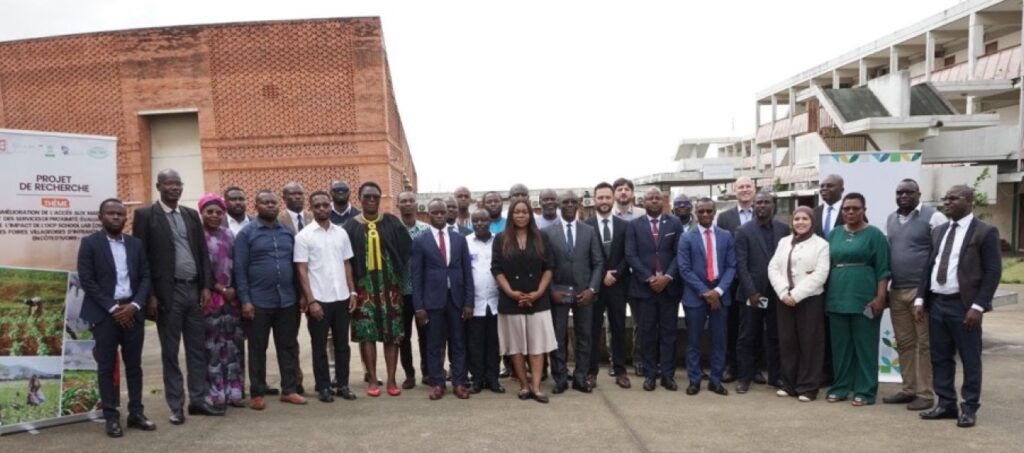
On Wednesday, 3 June 2026, the Univereity of Félix Houphouët-Boigny hosted a workshop dedicated to the UJALA project, titled “Improving Access to Markets and Local Services: Assessing the Impact of the OCP School Lab (OSL) and Village Input Fairs (VIF) in Côte d’Ivoire.” The event provided an opportunity to present the preliminary findings of the baseline survey, gather feedback from field stakeholders, and engage decision-makers to foster ownership of the results.

Discussions reviewed the progress of the project, highlighted farming practices and barriers to market access, and assessed the relevance of the OSL and VIF interventions. Participants emphasized the importance of adapting project activities to enhance the effectiveness of the interventions and to prepare for the endline survey. The workshop also aimed to mobilize authorities and partners in support of a potential scaling-up of the solutions being tested.

Speakers and participants included representatives from CIRES (CAPEC), the Village Input Fairs Fund, Interdisciplinary Policy-Oriented Research on Africa (IPORA), OCP Côte d’Ivoire, UJALA, cooperatives and agro-dealers, as well as national institutions such as ANADER, CNRA, the National Institute of Statistics, and the Ministry of Agriculture and Rural Development.

The workshop was organized into three sessions and featured constructive and engaging discussions, which participants described as both productive and collegial.

Webinar | Expanding Access to HIV Treatment for Children and Adolescents in Africa

22 June 2026

Webinar | Expanding Access to HIV Treatment
for Children and Adolescents in Africa

Presenter

Dr. Chishala Chabala
Pédiatre au CHU de Lusaka
School of Medicine, University of Zambia

Title

Expanding Access to HIV Treatment for children and adolescents: Progress and Persistent challenges

Watch the Webinar

Bio

Chishala Chabala is a Lecturer and Consultant Paediatrician at the University of Zambia, School of Medicine and the University Teaching Hospital in Lusaka, Zambia, where he teaches, conducts research, and provides clinical care.
He leads a clinical research group that focuses on children with tuberculosis, HIV, and pneumonia and has been an investigator in several international clinical trials, including those for children living with HIV (CHAPAS-3, -4, and Empirical trials).
He is the current Vice-Chair of the Child and Adolescent TB Working Group of the STOP TB Partnership, administered by the WHO.
More information on Dr Chishala Chabala

Resume

40 million people were living with HIV, with over two thirds of these residing in Africa, predominantly in Southern Africa. Globally, progress has been made towards universal access to antiretroviral therapy and the reduction in transmission from a mother living with HIV to her child.
However, antiretroviral treatment coverage among children under 15 years living with HIV remains low, with just over half receiving treatment of the 1.4 million children with HIV compared to 78% in adults.
Evidence shows that early initiation of antiretroviral therapy is lifesaving, yet coverage of these critical interventions including access to HIV testing, treatment and viral suppression remain inadequate, particularly in Africa, where >90% of children requiring HIV treatment live.
This talk will highlight progress in improving access to simplified antiretroviral regimens for children, as well as the ongoing challenges and efforts to bridge treatment access gaps and achieve global HIV treatment goals.

IPORA Summer School 2026 in Abidjan: cross-methodological approaches for interdisciplinary research

18 May 2026

IPORA Summer School 2026 in Abidjan:
cross-methodological approaches for interdisciplinary research

From 15 to 17 July 2026, IPORA will organise its Summer School in Abidjan, Côte d’Ivoire, dedicated to cross-methodological approaches in interdisciplinary research for the development of societies.

Conducted in French (with English interpretation available for certain sessions), this summer school will take place in a hybrid format, with in-person workshops in Abidjan (by application) and sessions accessible online (by registration).

IPORA – Interdisciplinary Policy-Oriented Research on Africa is an international research network established in 2022 to promote interdisciplinary, collaborative research focused on public policy in Africa. Adopting a research-based training approach, the IPORA 2026 Summer School offers an active learning environment dedicated to cross-methodological approaches within an interdisciplinary context. It will enable participants to explore innovative methods to better understand the complexity of contemporary challenges in Africa, through theoretical input and practical application, interdisciplinary exchanges and group work.

Objectives

General objective

This summer school aims to strengthen the methodological and analytical capacities of early-career researchers in the design, conduct and dissemination of interdisciplinary research focused on public policy in Africa.

Specific objectives

Specifically, the summer school aims to:

  • train participants in the main methodological approaches used in interdisciplinary research;
  • promote the application of methodological skills through the collaborative analysis of concrete issues related to the scientific priorities of the IPORA consortium;
  • encourage the emergence of scientific interactions and academic collaborations between researchers from different disciplines and institutions;
  • stimulate the co-development of interdisciplinary research projects or initiatives between participants, academic staff and partner institutions.

Programme

The detailed programme of the IPORA 2026 Summer School is now available.

Download Programme

Over three days, the summer school will combine keynote presentations, methodological sessions, case studies, practical workshops and supervised group work on interdisciplinary research.

The programme will address key issues such as research questions and data collection tools, analysis and dissemination, and the translation of interdisciplinary evidence into policy recommendations.

Participants will also take part in tutored group projects designed to encourage interdisciplinary dialogue and collaborative methodological reflection.

Who is this summer school aimed at?

The IPORA 2026 Summer School is designed for participants interested in interdisciplinary approaches to development, public policy and social transformation in Africa. It brings together advanced Master’s students, PhD students, post-doctoral researchers, early-career researchers, lecturers and researchers, as well as professionals involved in research, development or public policy.

The programme combines online sessions open to a wider registered audience with in-person activities in Abidjan for selected participants.

=> Online participation

Some sessions will be accessible remotely for registered participants.

=> In-person participation in Abidjan

Practical workshops, group work and methodological discussions will take place in person in Abidjan with a limited group of selected participants. These activities are intended to support active engagement, collaborative work and the supervised project developed as part of the summer school.

Registration and selection process

Registration for the IPORA Summer School 2026 is now closed.

Applications were open until 3 June 2026. Applicants were invited to complete an online registration form and submit a detailed CV.

For participants applying to attend the in-person workshops in Abidjan, places were limited to 20 and allocated on an application basis.

Applications were assessed on the basis of the applicant’s profile, motivation, the relevance of their research or professional project to interdisciplinary approaches, and their potential to contribute to collaborative work.

Selected participants have been contacted by the organizing team with further information regarding the programme and practical arrangements.

In summary

IPORA 2026 Summer School
📍 Abidjan, Côte d’Ivoire
📅 15–17 July 2026
🗣️ Language: French / English
🌐 Hybrid format: in-person & online
👥 In-person workshops: selected participants only
💻 Online participation: registered participants only
📩 Registration: closed

Contact

For further information:
Gerard Menan: gerard.menan@pac-ci.org
Yanick Mvodo: yanick.mvodo@u-bordeaux.fr
École d’été IPORA 2026 à Abidjan : approches méthodologiques croisées pour la recherche interdisciplinaire

18 May 2026

École d’été IPORA 2026 à Abidjan :
approches méthodologiques croisées pour la recherche interdisciplinaire

(See en English)

Du 15 au 17 juillet 2026, IPORA organisera à Abidjan, en Côte d’Ivoire, son École d’été consacrée aux approches méthodologiques croisées dans la recherche interdisciplinaire au service du développement des sociétés.

Organisée en français (avec options d’interprétariat en anglais sur certaines sessions), cette école d’été se tiendra en format hybride, avec des ateliers en présentiel à Abidjan, sur candidature, et des sessions accessibles en ligne, sur inscription.

IPORA – Interdisciplinary Policy-Oriented Research on Africa est un réseau international de recherche créé en 2022 pour promouvoir une recherche interdisciplinaire, collaborative et orientée vers l’action publique en Afrique.

Dans une démarche de formation par la recherche, l’École d’été IPORA 2026 propose un cadre d’apprentissage actif consacré aux approches méthodologiques croisées dans un contexte d’interdisciplinarité. Elle permettra aux participants d’explorer des méthodes innovantes pour mieux comprendre la complexité des enjeux contemporains en Afrique, à travers des apports théoriques et des mises en pratique, des échanges interdisciplinaires et des travaux de groupe.

Objectifs

Objectif général

Cette école d’été vise à renforcer les capacités méthodologiques et analytiques des jeunes chercheurs dans la conception, la conduite et la valorisation de recherches interdisciplinaires orientées vers les politiques publiques en Afrique.

Objectifs spécifiques

De façon spécifique, l’école d’été vise à :

  • former les participants aux principales approches méthodologiques mobilisées dans la recherche interdisciplinaire ;
  • favoriser l’application des acquis méthodologiques à travers l’analyse collaborative de problématiques concrètes liées aux axes scientifiques du consortium IPORA ;
  • encourager l’émergence des interactions scientifiques et des collaborations académiques entre les chercheurs de différentes disciplines et de différentes institutions ;
  • stimuler la co-construction de projets ou d’initiatives de recherche interdisciplinaires entre participants, enseignants-chercheurs et institutions partenaires.

À qui s’adresse cette école d’été ?

L’École d’été IPORA 2026 s’adresse à un public intéressé par les approches interdisciplinaires appliquées aux enjeux du développement, des politiques publiques et des transformations sociales en Afrique : étudiants de master avancé, doctorants, post-doctorants, jeunes chercheurs, enseignants-chercheurs, ainsi que professionnels impliqués dans la recherche, le développement ou l’action publique.

Deux modalités de participation sont proposées :

=> Participation en ligne

Certaines sessions accessibles à distance seront ouvertes à un large public, sur inscription préalable via un formulaire en ligne. Le lien de connexion sera communiqué vers la fin du mois de juin aux personnes inscrites.

=> Participation en présentiel à Abidjan

Certaines sessions, dont les ateliers pratiques et travaux de groupe, seront organisées en présentiel à Abidjan, et seront limités à 20 participants sélectionnés sur dossier. Cette participation s’adresse en priorité aux personnes souhaitant s’impliquer activement dans les travaux de groupe, les échanges méthodologiques et le projet tutoré proposé dans le cadre de l’école d’été.

Programme

Les détails du programme vous seront communiqués très prochainement.
Il comprendra notamment :

  • Une session introductive sur l’interdisciplinarité : besoins et enjeux
  • Des sessions de formation théorique sur la conduite de recherche interdisciplinaire sur des thématiques phares IPORA (systèmes alimentaires et nutrition des populations, équité sociale, santé globale, sécurité environnementale, entre autres)
  • Des ateliers pratiques de mise en situation – dialogue interdisciplinaire, formulation de questions et méthodologies de recherche, articulation de données interdisciplinaires
  • La réalisation de projets interdisciplinaire menés par des groupes de 4 ou 5 étudiants issus de différentes disciplines, et encadrés par au moins 2 tuteurs (chercheurs, enseignants)

Modalités de participation

Les personnes intéressées sont invitées à remplir un formulaire d’inscription en ligne avant le 3 juin 2026.

Formulaire d’inscription

Il leur sera demandé de soumettre un CV détaillé, 2 pages maximum

=> Participer aux ateliers en présentiel à Abidjan

La participation aux ateliers en présentiel est limitée à 20 places et se fait sur candidature.

  • Les personnes intéressées sont invitées à envoyer une lettre de motivation en lien avec leur projet de recherche ou professionnel
  • Cette lettre est à soumettre en ligne également
  • Formulaire à compléter (bouton présenté plus haut)

Les candidatures seront examinées en fonction du profil, de la motivation, de l’intérêt du projet ou du parcours pour les approches interdisciplinaires, ainsi que du potentiel de contribution aux travaux collectifs.

En résumé

École d’été IPORA 2026
📍 Abidjan, Côte d’Ivoire
📅 15–17 juillet 2026
🗣️ Langue : français / anglais
🌐 Format hybride : présentiel & distanciel
👥 Ateliers en présentiel : 20 places disponibles
📩 Date limite de candidature pour le présentiel : 3 juin 2026
💻 Participation en ligne : inscription via formulaire
🔗 Lien de connexion communiqué fin juin aux inscrits

Contact

Pour toute information complémentaire :
Gerard Menan : gerard.menan@pac-ci.org
Yanick Mvodo : yanick.mvodo@u-bordeaux.fr

IPORA Scientific Conference 2026: Keynote by Jeffrey Sachs (VIDEO)

6 April 2026

VIDEO

Prof. Jeffrey Sachs keynote
at IPORA SAEAP 2026

During the IPORA SAEAP 2026 Conference in Addis Ababa, Prof. Jeffrey Sachs gave a keynote lecture entitled:

“The role of universities and research institutions
in driving Africa’s sustainable development.”

You can watch the full video below.

This keynote was one of the highlights of the conference, contributing to the broader discussions on research, policy and Africa–Europe academic partnerships.

Prof. Sachs is Director of the Center for Sustainable Development at Columbia University, University Professor at Columbia University, and President of the UN Sustainable Development Solutions Network.
He is widely recognized for his work on sustainable development, global public policy and international cooperation.

IPORA Scientific Conference 2026: Strengthening Africa–Europe Academic Partnership (SAEAP)

8 March 2026

Strengthening Africa–Europe Academic Partnership
for improving intersectoral governance

Addis Ababa University, Ethiopia
31 March – 3 April 2026

From 31 March to 3 April 2026, members and partners of the IPORA network will gather in Addis Ababa, Ethiopia, for the IPORA General Assembly and annual scientific conference, hosted this year by Addis Ababa University.

The event is organized in partnership with the University of Bordeaux, the University Félix Houphouët-Boigny (Abidjan) and the International University of Rabat, and will take place in hybrid format, allowing participants to join both in person and online.

Over four days, researchers, students and institutional partners will come together to present ongoing research, exchange ideas across disciplines and strengthen collaborations within the network.

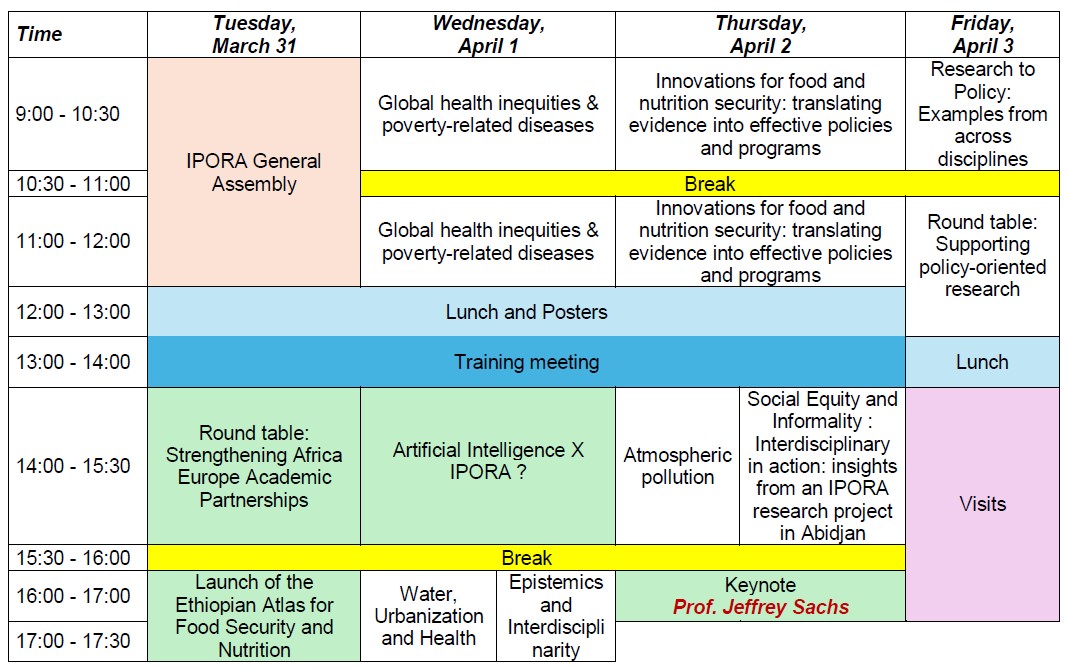
The conference will explore major challenges at the intersection of health, environment and society, with sessions addressing themes such as:

  • Health inequalities
  • Food security and nutrition
  • Pollution and environmental health
  • Water, urbanization and health
  • Social equity and informality
  • Research-to-policy dialogue, including exchanges with institutional partners and donors

The programme will also feature a keynote lectures by:
Prof. Jeffrey Sachs, Director of the Center for Sustainable Development at Columbia University, University Professor at Columbia, and President of the UN Sustainable Development Solutions Network.

We look forward to welcoming many of you in Addis Ababa or online for this important moment in the life of the IPORA network.

View and download the detailed programme